CLAVICLE FRACTURE FIXATION
This leaflet provides general information to help you understand surgery to fix a broken collarbone (clavicle fracture fixation).
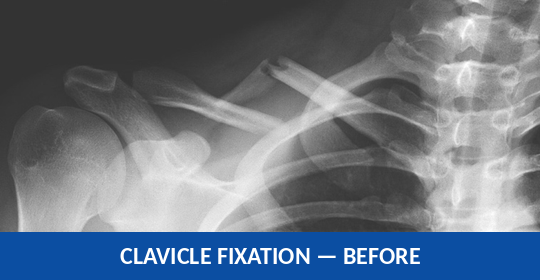
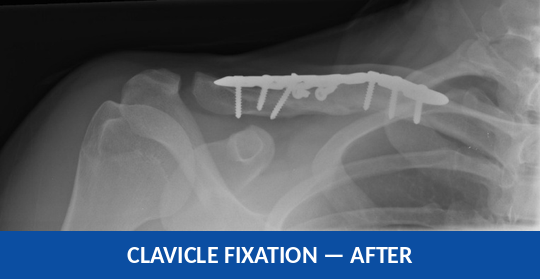
Realigning and holding the broken collarbone with a plate and screws to allow proper healing.
At the heart of my practice is Shared Decision-Making. Whether we pursue conservative management (Plan A) or surgical intervention (Plan B), the goal is to create a tailored treatment plan that aligns with your lifestyle, values, and functional goals.
This leaflet provides general information and does not replace individual medical advice.
The Anatomy of the Shoulder Joint
The shoulder is one of the most complex joints in the body, relying on several structures working together:
How the Shoulder Works
Three main bones form the joint:
- Humerus (upper arm bone)
- Clavicle (collarbone)
- Scapula (shoulder blade)
The Four Key Joints
- Glenohumeral Joint – the main ball-and-socket joint
- Acromioclavicular (AC) Joint – collarbone meets shoulder blade
- Subacromial Space – tunnel above the rotator cuff
- Scapulothoracic Joint – shoulder blade glides over rib cage
The Labrum (Stabilising Ring)
- A rim of rubbery tissue that deepens the shallow shoulder socket — like a "bumper" or suction cup that keeps the joint stable and prevents dislocation.
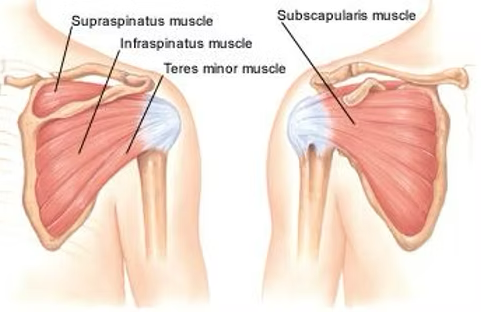
The Rotator Cuff
Four deep muscles keep the ball centred in the socket and let you lift and rotate your arm:
- Supraspinatus
- Infraspinatus
- Subscapularis
- Teres Minor
About the Operation
Most collarbone fractures heal without surgery. Fixation is offered when the bone is significantly out of place, badly shortened, in several pieces, at risk of breaking the skin, or slow to heal. The fragments are realigned and held with a metal plate and screws (occasionally a rod) so the bone heals in a good position.
Benefits & Logic
The operation aims to:
- Restore the normal alignment of the broken bone
- Hold the fracture stable so it heals correctly
- Allow earlier movement and reduce the risk of deformity
- Tailored treatment
The Procedure, Step by Step
The operation, step by step:
- Incision: made along the front of the collarbone
- Realignment: the bone fragments are put back in position
- Fixation: a plate and screws (or a rod) hold the bone
- Additional bone graft may be used to support healing
- Closure: dissolvable stitches, a dressing and a sling
Before, During & After Surgery
Before Surgery
- Fasting: no food for 6 hours, no drinks for 2 hours before
- Smoking: avoid for at least 12 hours before, to aid healing
- Medications: continue as advised by the pre-op team
- Please read 'Preparing for Surgery'
On the Day
- Admission: check in at main reception, then to your room
- Consultation: meet your surgeon and anaesthetist
- Preparation: timing and instructions are reviewed
Anaesthesia
- General anaesthetic with a nerve block that numbs the arm
- Nerve block alone (awake) if general anaesthetic is unsuitable
Recovery & Results
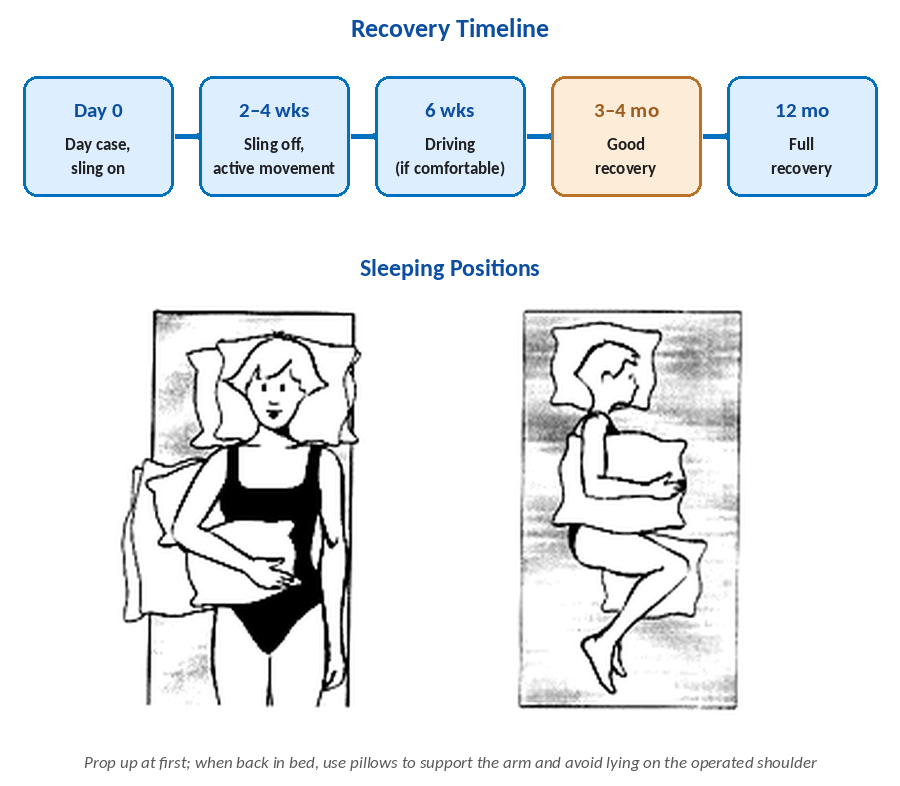
Recovery is a partnership. The timeline below is a guide — your physiotherapist and I will adapt it to you — this shared decision-making process ensures you are fully informed and involved in your care.
Recovery Milestones
- Sling: usually worn for 2–4 weeks
- Gentle exercises: begin as advised
- Recovery: most do well by 3–4 months
- Bone healing: usually complete by around 3 months
Results
Fixation gives reliable healing in a good position and allows earlier movement. The plate is only removed later if it causes irritation.
After Surgery — In the First Weeks
- Sling: usually worn for 2–4 weeks to protect the repair
- Pain Relief: start at home; take regularly for the first few days
- Wound Care: dressings changed at 24–48 hours; showering after 3–5 days
- Physiotherapy: gentle movement early, building up as the bone heals
Watch the Surgery Videos
For more information you can watch procedure videos at: www.youtube.com/c/ProfBijayendraSingh
Watch on YouTubeRisks & Complications
Uncommon, but possible:
- Anaesthetic: complications are rare
- Infection: fewer than 1 in 100; treated with antibiotics
- Numbness: a patch of numbness below the wound is common and usually settles in 9–12 months
- Plate Prominence: the plate can be felt and is sometimes removed later
- Non-union / Failure: uncommon; occasionally the bone is slow to heal and may require further intervention
- Malunion: healing in less-than-ideal position, uncommon after surgery
- Bleeding may occur
- Chronic Regional Pain Syndrome: causes pain and stiffness, uncommon and managed with therapy and pain medication
- Nerve Damage: serious nerve injury is rare but can happen
Return to Activities
This can be extremely variable and discuss with the surgeon. These are just guidelines.
Desk work 2–4 weeks; Sports is staged — your physiotherapist will guide the timeline. A member of the team will discuss your specific plan. Driving: 4–6 weeks when safe. Swimming: usually 4–6 weeks, Golf: 12–16 weeks, Contact Sports: 6 months. A member of the team will discuss your specific plan.
Recovery Timeline & Sleeping
⚠ Red Flags — When to Seek Urgent Help
Skin at risk over the fracture or plate, numbness or a cold hand, or fever and wound discharge — seek urgent assessment.
If you experience any of the above, contact the practice, your GP, NHS 111, or attend your nearest Emergency Department.
Key Points to Remember
- Used for displaced or complex fractures
- A plate and screws hold the bone to heal
- Allows earlier movement
- The plate is only removed if it causes trouble
Questions You May Wish to Ask
- When can I take the sling off?
- When can I drive and return to work?
- How much improvement can I expect?
- What happens if I don't have surgery?
Book or Enquire Directly at Each Site
| LIPS Healthcare London | 0203 870 9996 | singh.admin@lips.org.uk |
| Spire Alexandra Chatham | 01634 662866 | alexandraselfpaypsc@spirehealthcare.com |
| Practice Plus Gillingham | 01634 969045 | Private.gillingham@practiceplusgroup.com |