EXCISION OF OLECRANON BURSA +/− SPUR
This leaflet provides general information to help you understand surgery to remove an inflamed olecranon bursa, and any bone spur, at the point of the elbow.
This procedure removes the diseased bursa and any extra bone, and is usually a day case.
At the heart of my practice is Shared Decision-Making. Whether we pursue conservative management (Plan A) or surgical intervention (Plan B), the goal is to create a tailored treatment plan that aligns with your lifestyle, values, and functional goals.
This leaflet provides general information and does not replace individual medical advice.
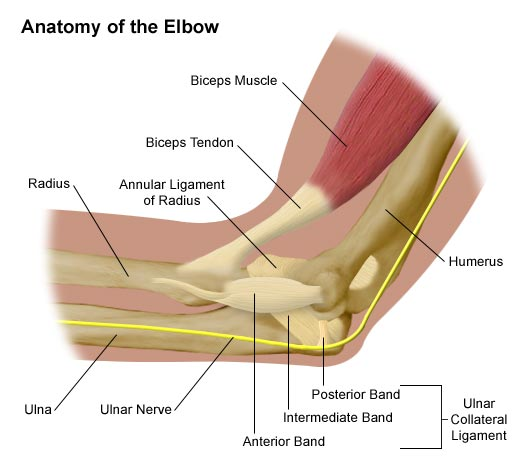
The Anatomy of the Elbow
The elbow is a hinged joint connecting the upper arm to the forearm, relying on several structures for stability and movement. The joint connects:
- Humerus (upper arm bone)
- Radius and Ulna (forearm bones)
- The olecranon (bony tip of the elbow)
What Is the Olecranon Bursa?
A small fluid-filled sac that cushions the bony tip of the elbow. When it becomes inflamed it swells, causing a tender lump at the back of the elbow.
What Causes It?
The bursa can become inflamed from:
- Repeated pressure or leaning on the elbow
- A knock or injury to the elbow
- A bone spur on the tip of the elbow
- Occasionally, infection
Common Symptoms
- A soft, swollen lump at the elbow tip
- Tenderness when leaning on the elbow
- Pain or restricted movement
- Repeated fluid build-up or inflammation
When Surgery Is Considered
When persistent swelling, pain or recurrent inflammation has not improved with aspiration, antibiotics, padding or activity modification (usually after 12–18 months).
About the Operation
Surgery removes the inflamed bursa and smooths or removes any bone spur causing irritation. It is usually a minor day-case operation with a predictable recovery, often under general anaesthesia.
At a Glance: Benefits
The operation aims to:
- Relieve pain by removing the inflamed bursa and bone spurs
- Reduce swelling by removing the fluid-filled sac
- Reduce the chance of the problem returning
The Procedure, Step by Step
- Incision: made over the back of the elbow
- Bursa removal: the swollen, thickened bursa is removed
- Spur removal: any bone spur on the tip is smoothed or removed
- Closure: stitches, a dressing and a supportive sling
Before, During & After Surgery
Before Surgery
- Fasting: no food for 6 hours, no drinks for 2 hours before (if under general anaesthetic)
- Smoking: avoid for at least 12 hours before, to aid healing
- Medications: continue as advised; no need to stop blood thinners
On the Day
- Admission: check in at main reception, then to your room
- Consultation: meet your surgeon and anaesthetist
- Preparation: timing and instructions are reviewed
Anaesthesia
- Most patients have a general anaesthetic combined with a local anaesthetic
- In selected patients, awake using a nerve block alone
Recovery & Results
Recovery is a partnership. The timeline below is a guide — your physiotherapist and I will adapt it to you — this shared decision-making process ensures you are fully informed and involved in your care.
- Sling: usually worn for 4–5 days
- Gentle hand use: begin as comfort allows
- Avoid heavy activity: for at least 4 weeks
- Recovery: exercises done regularly prevent stiffness
Most patients get good relief of the swelling and discomfort. There is a small risk of the bursa reforming.
After Surgery — The First Weeks
- Sling: worn for 4–5 days to support the arm and reduce swelling, or longer if needed; elevate the hand on pillows
- Pain Relief: a nerve block lasts 8–12 hours; start painkillers before it wears off, for 48–72 hours
- Wound Care: a splash-proof dressing and bulky bandage are applied; the bandage can come off after 24–48 hours; keep the wound dry until stitches are out
- Physiotherapy: essential to regain strength and mobility; exercises must be done regularly to prevent stiffness and improve elbow function
Risks & Complications
Uncommon, but possible.
- Scar: the scar may feel firm or tender for 2–3 months; massaging with a moisturising cream once healed can help
- Infection: rare unless there is a pre-existing infection; treated with antibiotics if needed
- Nerve Damage: rare, but possible due to the nerves around the elbow
- Stiffness / CRPS: a small number (about 5%) may have swelling, pain or stiffness afterwards; this is monitored and treated if needed
- Recurrence: there is a small risk of the bursa reforming, occasionally needing further treatment
Return to Work & Everyday Activities
Return-to-work timelines vary by role:
- Managerial / supervisory roles: 2–3 weeks
- Light manual labour (e.g. clerical): 6–8 weeks
- Heavy manual labour: 12–16 weeks
- Driving: once the wound has healed and pain is controlled; practise short trips first
- Lifestyle: avoid heavy lifting for at least 6–8 weeks; stopping smoking aids healing
Key Points to Remember
- A minor day-case operation
- Removes the swelling and eases discomfort
- Considered only after non-surgical treatment
- Gentle movement helps prevent stiffness
Questions You May Wish to Ask
- How soon can I return to work?
- When can I drive again?
- How much improvement can I expect?
- Could the swelling come back?
⚠ Red Flags — When to Seek Urgent Help
Spreading redness, discharge or a fever, worsening pain, or numbness and a cold hand — seek urgent assessment.
If you experience any of the above, contact the practice, your GP, NHS 111, or attend your nearest Emergency Department.
Book or Enquire Directly at Each Site
| LIPS Healthcare London | 0203 870 9996 | singh.admin@lips.org.uk |
| Spire Alexandra Chatham | 01634 662866 | alexandraselfpaypsc@spirehealthcare.com |
| Practice Plus Gillingham | 01634 969045 | Private.gillingham@practiceplusgroup.com |