THUMB BASE JOINT REPLACEMENT
This leaflet provides general information to help you understand joint replacement surgery for painful thumb base arthritis.
This day-case procedure replaces the worn joint while keeping thumb movement.
At the heart of my practice is Shared Decision-Making. Whether we pursue conservative management (Plan A) or surgical intervention (Plan B), the goal is to create a tailored treatment plan that aligns with your lifestyle, values, and functional goals.
This leaflet provides general information and does not replace individual medical advice.
The Anatomy of the Thumb Base
The thumb base is a mobile joint that lets you pinch and grip, relying on several structures working together.
How the Joint Works
A saddle-shaped joint gives the thumb its range:
- The thumb bone meets the trapezium wrist bone
- It works like a 'universal joint'
- This lets the thumb swivel, pinch and grip
The Cartilage
A smooth, slippery coating cushions the two bones so they glide over each other without friction, for pain-free movement.
What Goes Wrong
Cartilage gradually wears away:
- The smooth surface thins over time
- The bones begin to rub together
- This causes pain, swelling and weakness
- Bone spurs and a 'bump' can develop
As It Advances
- Pinch and grip become weaker
- A visible bump appears at the thumb base
- The thumb can take a 'zig-zag' shape
- It often coexists with other hand problems
The Result
Everyday tasks like opening jars, turning keys and pulling zips become painful, though many people have X-ray changes with little pain.
About the Operation
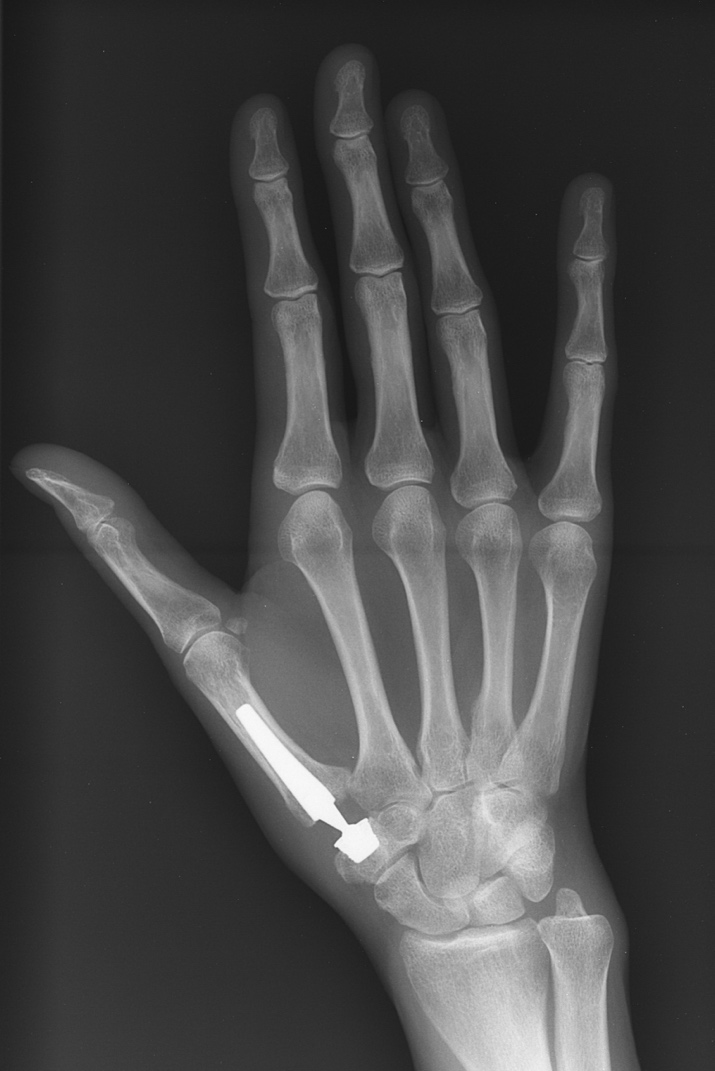
Thumb base joint replacement removes the worn joint surfaces and fits an artificial joint to relieve pain while preserving thumb movement and strength. It is a day-case operation, suited to painful thumb base arthritis that limits daily life when keeping motion is a priority.
Why It's Done
The operation aims to:
- Relieve pain from the worn joint
- Preserve thumb movement and strength
- Restore pinch, grip and fine hand use
The Procedure, Step by Step
The operation, step by step:
- Anaesthetic: regional or general anaesthetic
- Removal: the worn joint surfaces are removed
- Implant: an artificial joint is fitted to the prepared bones
- Closure: dissolvable stitches, dressing and a supportive splint
Before, During & After Surgery
Before Surgery
- Fasting: no food for 6 hours, no drinks for 2 hours before
- Smoking: avoid for at least 12 hours before, to aid healing
- Medications: continue as advised by the pre-op team
On the Day
- Admission: check in at main reception, then to your room
- Consultation: meet your surgeon and anaesthetist
- Preparation: timing and instructions are reviewed
Anaesthesia
- A regional or general anaesthetic is used
- Selected patients may have surgery awake with a block
Recovery & Results
Recovery is a partnership. The timeline below is a guide — I will adapt it to your healing and your goals — this shared decision-making process ensures you are fully informed and involved in your care.
Recovery Milestones
- Splint: supports the thumb for the first weeks
- Hand therapy: guided movement begins early
- Stitches: dissolvable; reviewed at about 2 weeks
- Good recovery: movement by 6 weeks, fuller by 3 months
Results
Joint replacement gives good pain relief while keeping thumb movement and strength. Most patients return to daily tasks; implant wear or loosening is uncommon.
After Surgery — The First Weeks
- Dressing & Splint: a supportive splint protects the thumb early on
- Pain Relief: start painkillers before the block wears off and take regularly for 24–48 hours
- Hand Therapy: guided movement begins early to restore motion
- Scar Care: gentle scar massage with cream once healed
Risks & Complications
Uncommon, but possible
- Infection: uncommon; treated with antibiotics if it occurs
- Stiffness: some early stiffness that improves with therapy
- Implant Wear: wear or loosening is uncommon but can need revision
- Nerve Irritation: temporary numbness near the scar can occur
- CRPS: rare; prolonged pain and stiffness needing therapy
Return to Activity
This can be extremely variable and discuss with the surgeon. These are just guidelines.
- Desk work: 2–3 weeks
- Light manual work: 6–8 weeks
- Heavy manual work: 12–16 weeks
- Driving: once comfortable and safe for an emergency stop
- Movement: improves with therapy over 3 months
Red Flags — When to Seek Urgent Help
Spreading redness, discharge or increasing pain, fever, or a thumb that turns pale or numb — seek urgent assessment.
If you experience any of the above, contact the practice, your GP, NHS 111, or attend your nearest Emergency Department.
Key Points to Remember
- Replaces the joint and keeps thumb movement
- Good pain relief with preserved strength
- Hand therapy guides your recovery
- Movement improves over about 3 months
Questions You May Wish to Ask
- When can I use my hand normally again?
- When can I drive and return to work?
- How much improvement can I expect?
- What are the signs of a problem?
Book or Enquire Directly at Each Site
| LIPS Healthcare London | 0203 870 9996 | singh.admin@lips.org.uk |
| Spire Alexandra Chatham | 01634 662866 | alexandraselfpaypsc@spirehealthcare.com |
| Practice Plus Gillingham | 01634 969045 | Private.gillingham@practiceplusgroup.com |