SUBACROMIAL IMPINGEMENT / ROTATOR CUFF TENDINOPATHY / SHOULDER BURSITIS
This leaflet provides general information to help you understand subacromial impingement and rotator cuff tendinopathy and the available treatment options.
Not everyone with impingement needs surgery.
At the heart of my practice is Shared Decision-Making. Whether we pursue conservative management (Plan A) or surgical intervention (Plan B), the goal is to create a tailored treatment plan that aligns with your lifestyle, values, and functional goals.

This leaflet provides general information and does not replace individual medical advice.
The Anatomy of the Shoulder Joint
The shoulder is one of the most complex joints in the body, relying on several structures working together.
How the Shoulder Works
Three main bones form the joint:
- Humerus (upper arm bone)
- Clavicle (collarbone)
- Scapula (shoulder blade)
The Four Key Joints
- Glenohumeral Joint – the main ball-and-socket joint
- Acromioclavicular (AC) Joint – collarbone meets shoulder blade
- Subacromial Space – tunnel above the rotator cuff
- Scapulothoracic Joint – shoulder blade glides over rib cage
The "Cushioning" (Articular Cartilage)
A smooth, slippery coating on the ball and socket surfaces that lets the bones glide over each other without friction, for pain-free movement.
The Labrum (Stabilising Ring)
A rim of rubbery tissue that deepens the shallow shoulder socket — like a "bumper" or suction cup that keeps the joint stable and prevents dislocation.

The Rotator Cuff
Four deep muscles keep the ball centred in the socket and let you lift and rotate your arm:
- Supraspinatus
- Infraspinatus
- Subscapularis
- Teres Minor
What Is Subacromial Impingement?
Impingement is a mechanical problem — the commonest cause of shoulder pain in the active adult. When you lift the arm, the space under the "roof" of the shoulder narrows; bone spurs, a swollen tendon, or poor movement patterns cause the roof to pinch the tendons and bursa beneath.
Three Related Problems
Often found together:
- Impingement – mechanical pinching under the roof
- Tendinopathy – a swollen, worn, thickened tendon
- Cuff tears – partial or full, often painless with age
Causes
Why the space narrows:
- Bone spurs under the acromion
- Swelling of the tendon or bursa
- Poor shoulder-blade movement patterns
- Overhead work and repetitive load
Symptoms & Examination
Symptoms
- The "painful arc" – worst between waist and head height
- Night pain – difficulty sleeping on that side
- Sharp pain reaching behind the back
Examination
- Painful arc and impingement tests
- Cuff strength assessed
- Neck and other causes excluded
Diagnosis
- X-rays – bone spurs and abnormalities
- Ultrasound or MRI – tendon quality, tears, bursitis
Example MRI images of the shoulder:
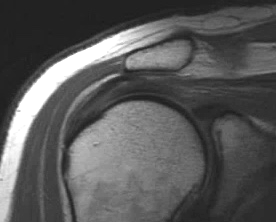
Normal
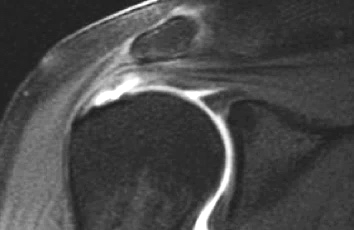
Partial Thickness

Full Thickness
Treatment Options: A Shared Decision
I will discuss all available treatment options with you, explaining the benefits and risks of each. Your preferences, values, and lifestyle will be considered as we work together to create a treatment plan best suited to your needs — this shared decision-making process ensures you are fully informed and involved in your care.
Treatment Depends On
- Tendon quality and any tear
- Duration and severity of symptoms
- Response to physiotherapy (3–6 months)
- Your activity level and goals
Good News
Most impingement settles without surgery — a 3–6 month trial of non-operative treatment is usually recommended first.
Plan A — Non-Surgical
Many people improve with:
- Physiotherapy: the most important treatment – strengthening the cuff creates more space
- Pain Control: regular painkillers or prescribed pain relief
- Injections: steroid for flare-ups; PRP to support tendon healing
- Activity: modifying aggravating tasks
Plan B — Surgical
Considered when…
- Persistent Symptoms: despite 3–6 months of non-surgical care
- Daily Life: pain affecting sleep, work or activities
- Approach: keyhole subacromial decompression
- Combined: cuff repair if a significant tear is found
- Details: explained fully in a separate leaflet
- The Procedure: known as Arthroscopic Subacromial Decompression, this keyhole procedure creates more room by removing inflamed bursa and any bone spur; a cuff tear can be repaired at the same time. A separate leaflet will be provided for the surgery.
Management Pathway
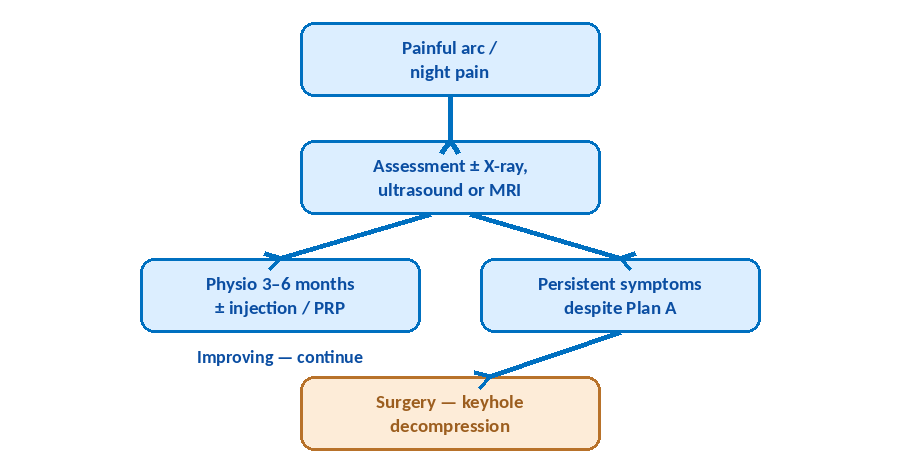
Red Flags — When to Seek Urgent Help
Sudden weakness or inability to lift the arm after an injury — seek prompt assessment, as an acute cuff tear may need early repair.
If you experience any of the above, contact the practice, your GP, NHS 111, or attend your nearest Emergency Department.
Important Things to Remember
- Scans aren't everything – many people have spurs or tears without pain
- Physiotherapy is the cornerstone (allow 12 weeks)
- A 3–6 month non-operative trial comes first
- Doing nothing is always an option
Questions You May Wish to Ask
- What treatments should I try first?
- How long should I try them for?
- What improvement can I expect?
- What happens if I don't have surgery?
Book or Enquire Directly at Each Site
| LIPS Healthcare London | 0203 870 9996 | singh.admin@lips.org.uk |
| Spire Alexandra Chatham | 01634 662866 | alexandraselfpaypsc@spirehealthcare.com |
| Practice Plus Gillingham | 01634 969045 | Private.gillingham@practiceplusgroup.com |