DISTAL BICEPS REPAIR / RECONSTRUCTION
This leaflet provides general information to help you understand surgery to repair or reconstruct a distal biceps tendon tear at the elbow.
This procedure reattaches the torn biceps tendon to the bone to restore strength and function.
At the heart of my practice is Shared Decision-Making. Whether we pursue conservative management (Plan A) or surgical intervention (Plan B), the goal is to create a tailored treatment plan that aligns with your lifestyle, values, and functional goals.
This leaflet provides general information and does not replace individual medical advice.
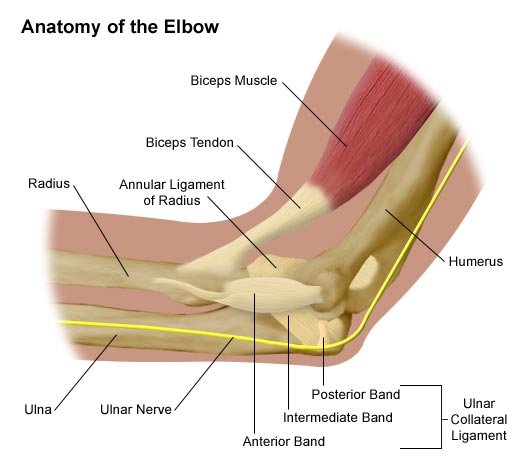
The Anatomy of the Elbow
The elbow is a hinged joint connecting the upper arm to the forearm, relying on several structures for stability and movement. The joint connects:
- Humerus (upper arm bone)
- Radius and Ulna (forearm bones)
- The biceps tendon (attaches to the radius)
What Is a Distal Biceps Tear?
The biceps tendon tears away from the radius bone at the elbow — often with a sudden “pop” during heavy lifting — causing weakness in bending the elbow and turning the palm up.
The Biceps Muscle
The biceps bends the elbow and rotates the forearm. It attaches at:
- The shoulder (two upper heads)
- The radius at the elbow (distal tendon)
- Repair restores the elbow attachment
- Nearby: the radial nerve
Common Symptoms
- A sudden pop, pain and bruising
- A change in the shape of the upper arm
- Weakness bending the elbow
- Weakness turning the palm upwards
Why Surgery Is Advised
Surgical repair is usually recommended to restore full strength, especially for active people, as the tendon does not reattach on its own.
About the Operation
Surgery reattaches the torn biceps tendon to the radius bone. Acute tears are usually repaired directly; chronic tears may need a tendon graft to bridge the gap. The approach is tailored to your injury and discussed with you.
Acute Tear Repair
For a recent (acute) tear:
- An incision is made at the front of the elbow
- A socket is drilled in the radius at the original attachment
- The tendon is secured into the socket using anchors
Chronic Tear Reconstruction
For an older (chronic) tear:
- A tendon graft may be needed to bridge the gap
- The graft is taken from your forearm or a screened donor
- It is stitched to the remaining tendon and anchored to bone
- The wound is closed and a back slab (half cast) applied
Before, During & After Surgery
Before Surgery
- Fasting: no food for 6 hours, no drinks for 2 hours before (if under general anaesthetic)
- Smoking: avoid for at least 12 hours before, to aid healing
- Medications: continue as advised by the pre-op team
On the Day
- Admission: check in at main reception, then to your room
- Consultation: meet your surgeon and anaesthetist
- Preparation: timing and instructions are reviewed
Anaesthesia
- General anaesthetic combined with a local anaesthetic or nerve block
- In selected patients, awake using a nerve block alone
Recovery & Results
Recovery is a partnership. The timeline below is a guide — your physiotherapist and I will adapt it to you — this shared decision-making process ensures you are fully informed and involved in your care.
- Sling / back slab: usually worn for 2–4 weeks
- Gentle hand use: begin as comfort allows
- Brace: an elbow brace may follow for 4–6 weeks
- Recovery: rehabilitation typically 3–4 months (up to a year for full recovery)
Most patients regain good strength and function. Recovery is slower after reconstruction; your physiotherapist will guide your progress.
After Surgery — The First Weeks
- Sling: the arm is immobilised in a back slab and sling for 2–4 weeks; a brace may follow; elevate the hand on pillows
- Pain Relief: a nerve block lasts 8–12 hours; start painkillers before it wears off, for 3–4 days
- Wound Care: a splash-proof dressing is applied; keep the wound dry until stitches are removed; dissolvable stitches, ends trimmed at 14 days
- Physiotherapy: essential to regain strength and mobility; avoid lifting, pulling or forceful rotation early on; progress is slower after reconstruction
Risks & Complications
Uncommon, but possible.
- Stiffness: temporary pain and mild stiffness are common; prolonged stiffness affects about 5%
- Infection: fewer than 1 in 200; treated with antibiotics, occasionally further surgery
- Nerve Symptoms: temporary numbness is common and usually recovers; serious nerve injury is rare (about 1 in 200)
- Fixation: the fixation can occasionally fail (anchor pull-out or suture problem); uncommon but may need further surgery
- Repair Failure: rarely, new bone (heterotopic ossification) or a bony bridge between the forearm bones can form, causing stiffness
Return to Work & Everyday Activities
Return-to-work timelines vary by role:
- Managerial / supervisory roles: 2–3 weeks
- Light manual labour (e.g. clerical): 6–8 weeks
- Heavy manual labour: 12–16 weeks
- Driving: usually 2–6 weeks, once healed, pain-free and with sufficient arm mobility
- Sport: swimming 4–6 weeks after sling removal, golf 6–8 weeks, contact sports after 6 months
Key Points to Remember
- Reattaches the biceps tendon to the bone
- Restores strength and forearm rotation
- A brace protects the repair while it heals
- Physiotherapy is essential to recovery
Questions You May Wish to Ask
- How soon can I return to work?
- When can I drive again?
- How much improvement can I expect?
- What are the signs of a problem?
⚠ Red Flags — When to Seek Urgent Help
Spreading redness, discharge or a fever, worsening pain, or numbness and a cold hand — seek urgent assessment.
If you experience any of the above, contact the practice, your GP, NHS 111, or attend your nearest Emergency Department.
Book or Enquire Directly at Each Site
| LIPS Healthcare London | 0203 870 9996 | singh.admin@lips.org.uk |
| Spire Alexandra Chatham | 01634 662866 | alexandraselfpaypsc@spirehealthcare.com |
| Practice Plus Gillingham | 01634 969045 | Private.gillingham@practiceplusgroup.com |