DISTAL BICEPS RUPTURE
This leaflet provides general information to help you understand a rupture of the distal biceps tendon and the available treatment options.
Not everyone with a distal biceps rupture needs surgery.
At the heart of my practice is Shared Decision-Making. Whether we pursue conservative management (Plan A) or surgical intervention (Plan B), the goal is to create a tailored treatment plan that aligns with your lifestyle, values, and functional goals.
This leaflet provides general information and does not replace individual medical advice.
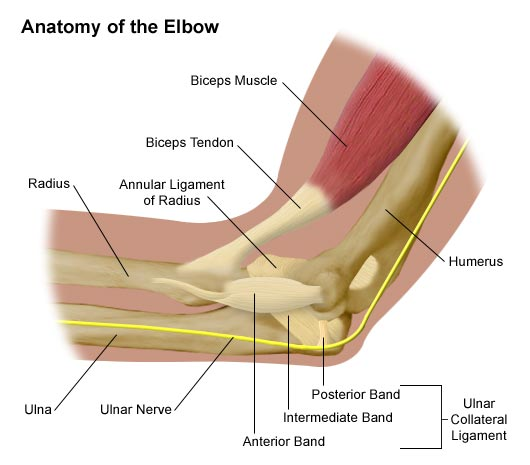
Anatomy of the Elbow
The elbow is a hinged joint connecting the upper arm to the forearm, relying on several structures for stability and movement. The joint connects:
- Humerus — upper arm bone
- Radius and Ulna — forearm bones
Stability
Maintained by the shape of the bones and collateral ligaments on each side.
Nerve Considerations
- The ulnar nerve runs behind the inner elbow (medial epicondyle).
- Bone spurs (osteophytes) can compress this nerve, causing numbness, tingling, or weakness in the ring and little fingers.
Understanding Distal Biceps Rupture
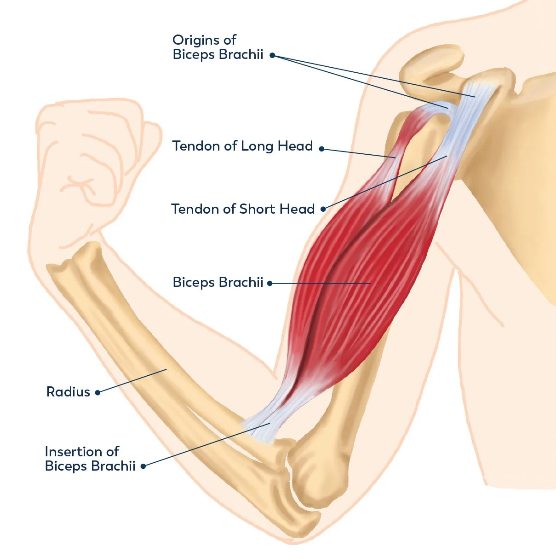
The biceps muscle has two attachments at the shoulder and one at the elbow. A distal biceps rupture is an injury where the tendon that attaches the biceps muscle to the forearm (the radius bone) tears away.
This tendon is the "power generator" for your arm. It is essential for bending the elbow and, more importantly, for supination — the twisting motion used to turn a screwdriver or open a stiff jar.
Acute Injuries
Sudden tears, often occurring during a heavy lift (like moving furniture or deadlifting) or when catching a falling object. You will likely feel a sharp pain and a distinct "pop."
Chronic Injuries
If a tear is not treated within 4–6 weeks, the muscle begins to scar and retract further into the arm, which can lead to permanent weakness and "fatigue-type" aching in the forearm.
Signs of a Rupture
- The "Reverse Popeye" Deformity: because the tendon no longer anchors the muscle at the elbow, the biceps bunches up toward the shoulder.
- Bruising and Swelling: often appears in the pit of the elbow and spreads down the forearm.
- Weakness: you can still bend your arm using other muscles, but will notice a significant loss of strength when twisting your forearm or lifting.
Diagnosis
I will look for the "gap" in your elbow and perform the Hook Test — attempting to hook a finger under the tendon. If it has ruptured, there is nothing to hook.
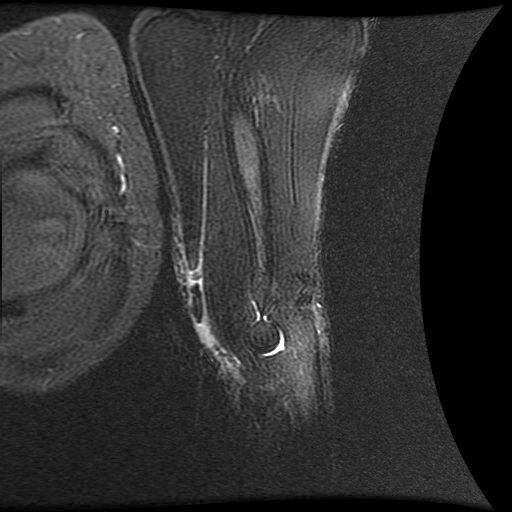
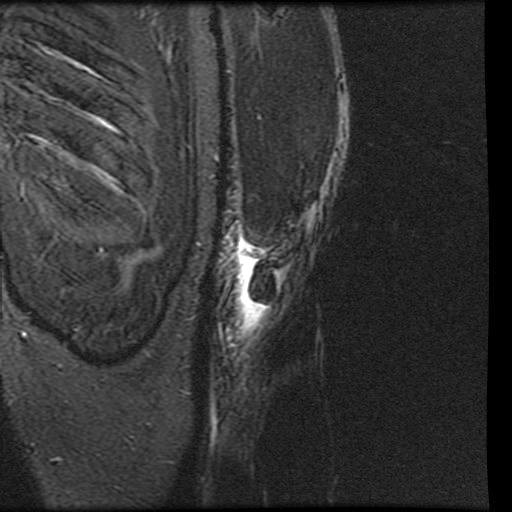
- MRI: the most important test — confirms if the tear is complete or partial and shows how far the muscle has retracted, helping plan surgery.
- X-ray: done to ensure no small pieces of bone were pulled away during the injury.
The "Reverse Popeye" sign:

MRI imaging — confirming the tear and retraction:
Treatment Options: A Shared Decision
I will discuss all available treatment options with you, explaining the benefits and risks of each. Your preferences, values, and lifestyle will be considered as we work together to create a treatment plan best suited to your needs — this shared decision-making process ensures you are fully informed and involved in your care.
Plan A — Non-Surgical
Usually reserved for lower physical demands or high surgical risk
- Outcome: you will keep the ability to bend your arm, but will likely lose about 60% of twisting power (supination) and 30% of flexion strength.
- Rehab: physical therapy to strengthen surrounding muscles (like the brachialis) to compensate for the lost biceps power.
Plan B — Surgical
Generally recommended for active individuals
- The Procedure: we reattach the torn tendon to the radius bone using specialised buttons or anchors.
- Timing: for the best results, surgery should ideally be performed within 3 weeks of the injury before the tendon becomes too scarred or retracted.
- Chronic Repair: if the injury is old, a tissue graft may be needed to bridge the gap if the tendon can no longer reach the bone.
Important Things to Remember
- A distal biceps tear is not dangerous
- Many people improve without surgery
- Surgery is optional
- Doing nothing is always an option
Questions You May Wish to Ask
- What treatments should I try first?
- How long should I try them for?
- What improvement can I expect?
- What happens if I choose not to have surgery?
Book or Enquire Directly at Each Site
| LIPS Healthcare London | 0203 870 9996 | singh.admin@lips.org.uk |
| Spire Alexandra Chatham | 01634 662866 | alexandraselfpaypsc@spirehealthcare.com |
| Practice Plus Gillingham | 01634 969045 | Private.gillingham@practiceplusgroup.com |