BICEPS TENDINITIS & TEARS (LHB)
This leaflet provides general information to help you understand problems of the long head of biceps (LHB) and the available treatment options.
Not everyone with a biceps (LHB) problem needs surgery.
At the heart of my practice is Shared Decision-Making. Whether we pursue conservative management (Plan A) or surgical intervention (Plan B), the goal is to create a tailored treatment plan that aligns with your lifestyle, values, and functional goals.
This leaflet provides general information and does not replace individual medical advice.
The Anatomy of the Shoulder Joint
The shoulder is one of the most complex joints in the body, relying on several structures working together.
How the Shoulder Works
Three main bones form the joint:
- Humerus (upper arm bone)
- Clavicle (collarbone)
- Scapula (shoulder blade)
The Four Key Joints
- Glenohumeral Joint – the main ball-and-socket joint
- Acromioclavicular (AC) Joint – collarbone meets shoulder blade
- Subacromial Space – tunnel above the rotator cuff
- Scapulothoracic Joint – shoulder blade glides over rib cage
The "Cushioning" (Articular Cartilage)
A smooth, slippery coating on the ball and socket surfaces that lets the bones glide over each other without friction, for pain-free movement.
The Labrum (Stabilising Ring)
A rim of rubbery tissue that deepens the shallow shoulder socket — like a "bumper" or suction cup that keeps the joint stable and prevents dislocation.
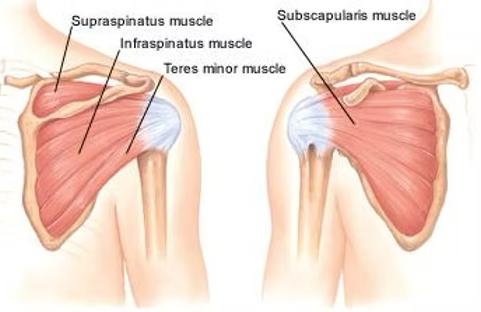
The Rotator Cuff
Four deep muscles keep the ball centred in the socket and let you lift and rotate your arm:
- Supraspinatus
- Infraspinatus
- Subscapularis
- Teres Minor
What Is an LHB Problem?
The long head of biceps (LHB) travels through the shoulder joint itself, which makes it vulnerable to wear and injury. Problems range from tendinitis (inflammation) and instability (slipping out of its groove) to partial and complete tears — pain often improves once a worn tendon finally gives way.
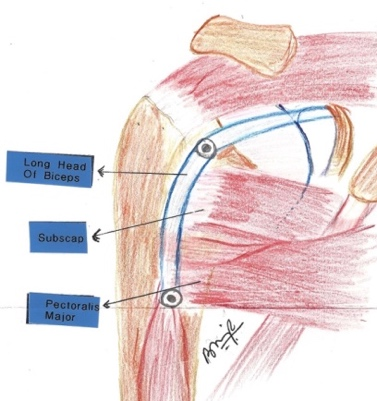
Common LHB Problems
The tendon can fail in several ways:
- Tendinitis – inflammation and thickening of the tendon
- Instability – the tendon slips out of its groove
- Partial or complete tears – fraying or rupture ("Popeye" bulge)
What Causes It?
Injury and wear, alone or combined:
- Falls onto an outstretched arm or heavy lifting
- Overuse – overhead sport or weight training
- Age-related wear and tear
- Smoking and long-term steroids weaken tendons
Symptoms and Examination
Symptoms
- Pain at the front of the shoulder, worse on loading
- A sudden "pop" with bruising down the arm
- A "Popeye" bulge above the elbow after a full tear
Examination
- Tenderness over the biceps groove
- "Popeye" sign checked
- Associated cuff and AC-joint problems assessed
Diagnosis
- X-rays for bone; ultrasound for the tendon
- MRI arthrogram – the most sensitive test for SLAP tears
The long head of biceps:

Superior labral (SLAP) tear
Treatment Options: A Shared Decision
I will discuss all available treatment options with you, explaining the benefits and risks of each. Your preferences, values, and lifestyle will be considered as we work together to create a treatment plan best suited to your needs — this shared decision-making process ensures you are fully informed and involved in your care.
Treatment Depends On
- Which part of the tendon is affected
- Associated cuff, SLAP or AC-joint problems
- Your age, arm demands and sport
- Response to non-surgical care
Good News
Not every biceps problem needs an operation — and pain often improves once a worn tendon finally gives way.
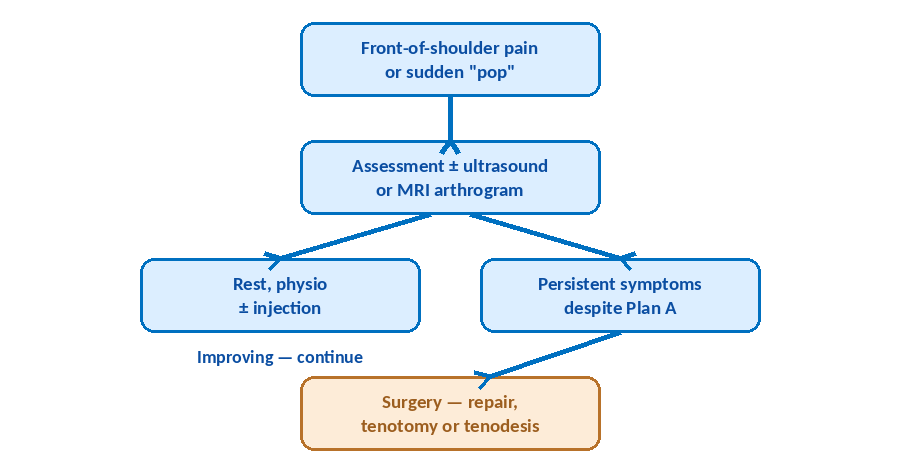
Plan A — Non-Surgical
Many people improve with:
- Rest: avoiding aggravating activities
- Pain Control: regular painkillers for pain relief
- Physiotherapy: mobility and strength rehabilitation
- Injection: ultrasound-guided cortisone – also helps confirm the source of pain
Plan B — Surgical
Considered when…
- SLAP Repair: re-attaching the labrum with small anchors
- Tenotomy: releasing the tendon from the socket
- Tenodesis: re-fixing the tendon to the arm bone
- Approach: keyhole, or a small open incision for severe tears
- Timing: when symptoms persist despite non-surgical care
- The Procedure: most biceps surgery is keyhole (arthroscopic); tenodesis may use a small 4–5 cm open incision if the tendon is severely torn. A separate leaflet will be provided for the surgery.
Management Pathway
Red Flags — When to Seek Urgent Help
A sudden pop with bruising down the arm and a new bulge in the upper arm — arrange prompt assessment; early review keeps every treatment option open.
If you experience any of the above, contact the practice, your GP, NHS 111, or attend your nearest Emergency Department.
Important Things to Remember
- Pain often precedes – and can improve after – a full tear
- Many LHB problems settle without surgery
- Overlapping conditions are treated together
- Treatment decisions are individual
Questions You May Wish to Ask
- What treatments should I try first?
- How long should I try them for?
- What improvement can I expect?
- What happens if I don't have surgery?
Book or Enquire Directly at Each Site
| LIPS Healthcare London | 0203 870 9996 | singh.admin@lips.org.uk |
| Spire Alexandra Chatham | 01634 662866 | alexandraselfpaypsc@spirehealthcare.com |
| Practice Plus Gillingham | 01634 969045 | Private.gillingham@practiceplusgroup.com |