TRIGGER FINGER RELEASE
This leaflet provides general information to help you understand surgery to release a trigger finger or thumb.
This day-case procedure frees the tendon, usually under local anaesthetic.
At the heart of my practice is Shared Decision-Making. Whether we pursue conservative management (Plan A) or surgical intervention (Plan B), the goal is to create a tailored treatment plan that aligns with your lifestyle, values, and functional goals.
This leaflet provides general information and does not replace individual medical advice.
The Anatomy of the Flexor Tendon
Tendons bend your fingers by sliding through a series of tunnels, relying on several structures working together.
How the Tendon Works
The tendon glides like a cable:
- A tendon runs along the front of each finger
- It slides through tunnels called pulleys
- This bends and straightens the finger
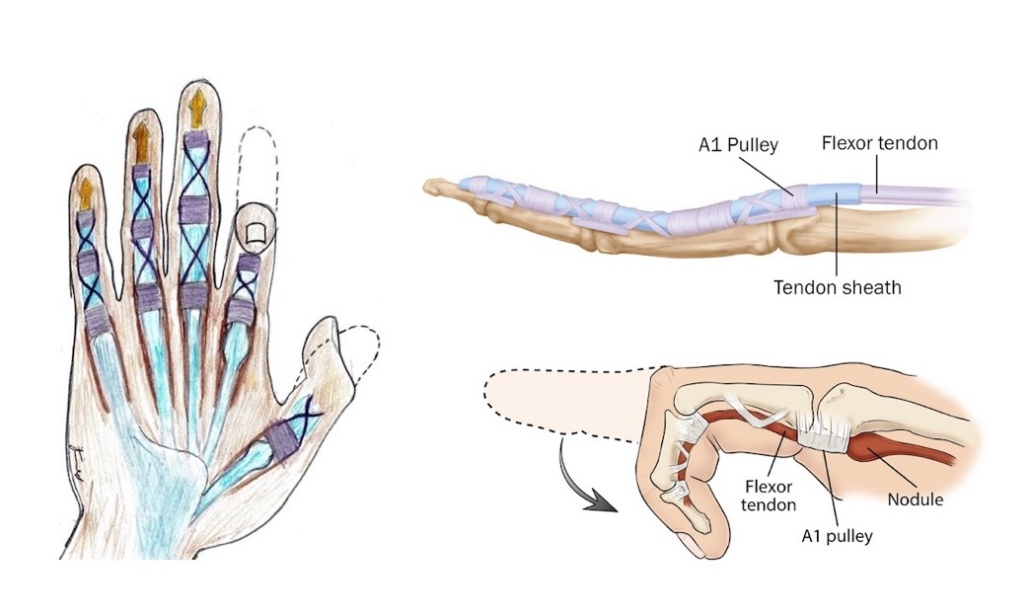
The Pulleys
Firm bands (pulleys) hold the tendon close to the bone so it can bend the finger smoothly and powerfully.
What Goes Wrong
Inflammation thickens the tendon:
- The tendon lining swells
- A small lump (nodule) forms
- It catches at the mouth of a pulley
- The finger clicks, snaps or locks
Where It Happens
- Usually at the A1 pulley in the palm
- At the base of the affected finger or thumb
- More than one digit can be affected
- Both hands can be involved
The Result
The finger catches or locks in a bent position, and can be painful or need the other hand to straighten it.
About the Operation
Trigger finger release divides the tight pulley at the base of the finger so the tendon glides freely, stopping the catching and locking. It is a short day-case operation, usually under local anaesthetic, recommended when catching persists despite splints and a steroid injection.
Why It's Done
The operation aims to:
- Stop the catching and locking
- Relieve pain from the irritated tendon
- Restore smooth, free finger movement
The Procedure, Step by Step
The day-case operation, step by step:
- Anaesthetic: the area is numbed with local anaesthetic
- Incision: a small cut is made at the base of the finger
- Release: the tight A1 pulley is divided so the tendon glides
- Closure: stitches and a splash-proof dressing
Before, During & After Surgery
Before Surgery
- Fasting: not needed for local anaesthetic (6 hours if general)
- Smoking: avoid for at least 12 hours before, to aid healing
- Medications: continue as advised; blood thinners can usually continue
On the Day
- Admission: check in at main reception, then to your room
- Consultation: meet your surgeon and anaesthetist
- Preparation: timing and instructions are reviewed
Anaesthesia
- Local anaesthetic is injected after the hand is cleaned
- A tourniquet may be used briefly to reduce bleeding
Recovery & Results
Recovery is a partnership. The timeline below is a guide — I will adapt it to your healing and your goals — this shared decision-making process ensures you are fully informed and involved in your care.
Recovery Milestones
- Bandage: bulky dressing removed after 24–48 hours
- Hand use: gentle finger and hand use straight away
- Stitches: removed at about 14 days
- Good recovery: light use by 2 weeks, fuller by 6–8 weeks
Results
Release is a reliable operation that stops the triggering, with a low recurrence rate. Most patients regain smooth finger movement quickly.
After Surgery — The First Weeks
- Wound Care: keep the wound clean and dry; the bulky bandage comes off at 24–48 hours
- Pain Relief: the local block lasts 4–6 hours; start painkillers before it wears off and take regularly for 24–48 hours
- Stitches: usually removed at about 14 days
- Scar Care: gentle scar massage with cream 2–3 times daily for 2–3 months; physiotherapy is usually not needed
Risks & Complications
Uncommon, but possible
- Infection: fewer than 1 in 200; treated with antibiotics if it occurs
- Scar Sensitivity: the scar can be tender for a few weeks; massage with cream helps
- Stiffness: mild stiffness is common early and improves with movement
- CRPS: rare (under 1 in 50); prolonged pain and stiffness needing therapy
- Incomplete Recovery: long-standing tendon changes may limit full recovery; recurrence is low
Return to Activity
This can be extremely variable and discuss with the surgeon. These are just guidelines.
- Desk work: 2–3 weeks
- Driving: when you can safely do an emergency stop, often 1–2 weeks
- Light manual work: 4–6 weeks
- Heavy manual work: 6–8 weeks
Avoid heavy lifting for 6–8 weeks.
Red Flags — When to Seek Urgent Help
Spreading redness, discharge or increasing pain in the wound, or fever — seek urgent assessment, as this may indicate infection.
If you experience any of the above, contact the practice, your GP, NHS 111, or attend your nearest Emergency Department.
Key Points to Remember
- Quick day-case surgery, usually local anaesthetic
- Reliable, with a low recurrence rate
- Physiotherapy is usually not needed
- Gentle scar massage helps the scar settle
Questions You May Wish to Ask
- When can I use my hand normally again?
- When can I drive and return to work?
- How much improvement can I expect?
- What are the signs of a problem?
Book or Enquire Directly at Each Site
| LIPS Healthcare London | 0203 870 9996 | singh.admin@lips.org.uk |
| Spire Alexandra Chatham | 01634 662866 | alexandraselfpaypsc@spirehealthcare.com |
| Practice Plus Gillingham | 01634 969045 | Private.gillingham@practiceplusgroup.com |