de QUERVAIN'S TENOSYNOVITIS
This leaflet provides general information to help you understand de Quervain's tenosynovitis and the available treatment options.
Not everyone with de Quervain's needs surgery.
At the heart of my practice is Shared Decision-Making. Whether we pursue conservative management (Plan A) or surgical intervention (Plan B), the goal is to create a tailored treatment plan that aligns with your lifestyle, values, and functional goals.
This leaflet provides general information and does not replace individual medical advice.

The Anatomy of the Thumb-Side Tendons
On the thumb side of the wrist, two tendons run together through a narrow tunnel, relying on several structures working together.
How the Tendons Work
A narrow tunnel guides the thumb tendons:
- Two tendons move the thumb away from the hand
- They pass through a tunnel (the first compartment)
- A sheath lets them glide smoothly
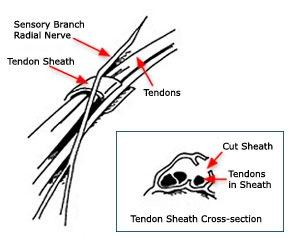
The Tendons
Abductor pollicis longus and extensor pollicis brevis run side by side to lift and straighten the thumb.
The Sheath (Tunnel)
A fibrous tunnel holds the tendons against the wrist:
- Keeps the tendons close to the bone
- Lined by a slippery membrane
- Normally lets the tendons slide freely
- Sits over the thumb-side wrist bone
What Goes Wrong
- The sheath lining thickens and swells
- The tunnel becomes tight
- The tendons can no longer glide freely
- Friction causes pain on thumb use
The Result
Moving the thumb and wrist becomes painful, and a catching or grating can be felt over the tunnel.
What Is de Quervain's?
De Quervain's is a painful condition affecting the tendons on the thumb side of the wrist. It occurs when the lining of the sheath around these tendons becomes inflamed or thickened, restricting movement and causing friction and pain.
Who Gets It
Most common in certain groups:
- Women aged 20 to 50, most often
- New parents lifting a baby ('mother's thumb')
- Later pregnancy, from fluid retention
What Causes It?
The exact cause isn't always clear:
- Repetitive thumb and wrist movements
- Texting, gardening or manual work
- Fluid retention around the tendons
- Thickening of the tendon sheath
Symptoms & Examination
Symptoms
- Pain and tenderness on the thumb side of the wrist
- Swelling near the base of the thumb
- Snapping, catching or grating on thumb movement
Examination
- The tender tunnel is felt over the wrist
- Finkelstein's test reproduces the pain
- Grip and pinch movements assessed
Diagnosis
- Usually a clinical diagnosis from examination
- Ultrasound or X-ray occasionally to exclude other causes
Treatment Options: A Shared Decision
I will discuss all available treatment options with you, explaining the benefits and risks of each. Your preferences, values, and lifestyle will be considered as we work together to create a treatment plan best suited to your needs — this shared decision-making process ensures you are fully informed and involved in your care.
Treatment Depends On
- How severe and long-standing the symptoms are
- How much thumb use your daily life needs
- Your response to splints and injections
- Your preferences and goals
Many people improve with simple measures — symptoms often settle with rest, splints or an injection, and doing nothing is always an option.
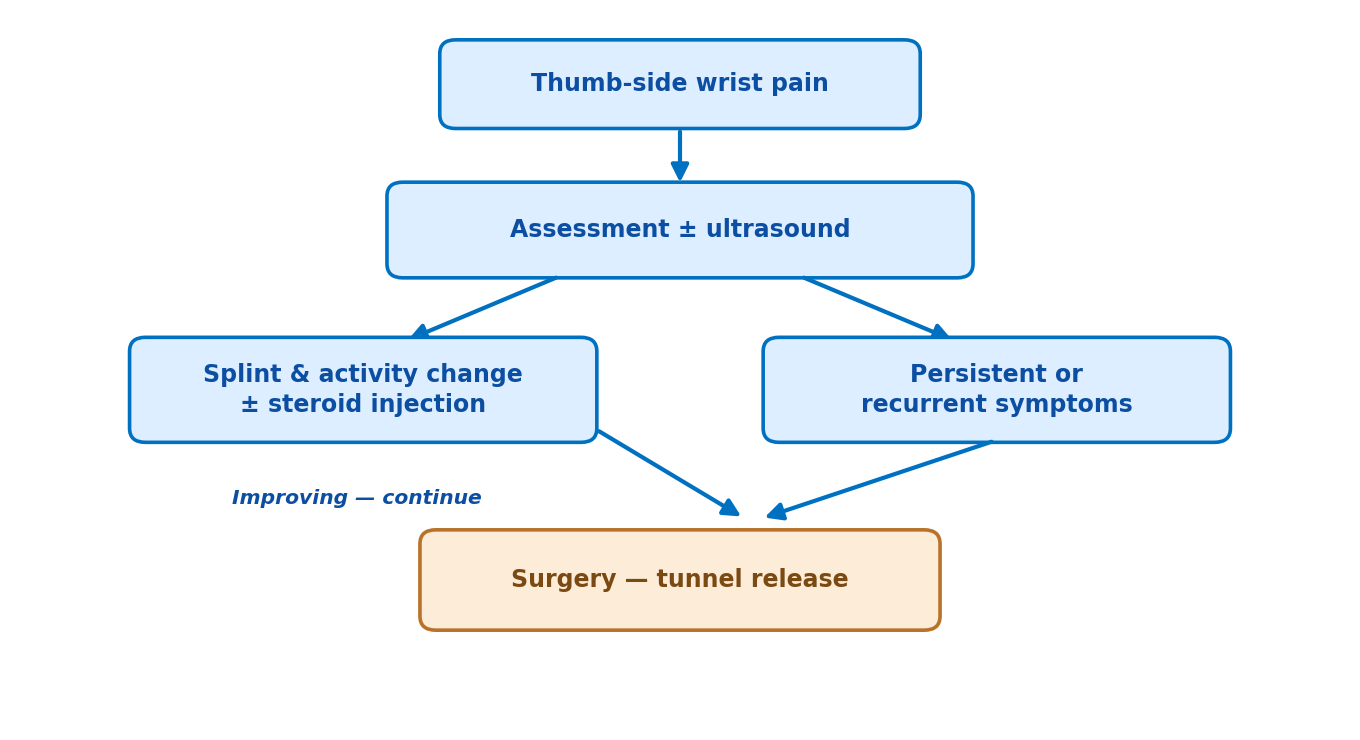
Plan A — Non-Surgical
- Activity: avoiding repetitive gripping and forceful thumb movements
- Splints: a thumb splint rests the tendons and eases swelling
- Anti-inflammatories: NSAID gels or tablets reduce pain and swelling
- Injection: steroid around the sheath helps in about two-thirds of cases
Plan B — Surgical
Considered when…
- Persistent Symptoms: despite splints, medication and injection
- Daily Life: pain keeps limiting grip and thumb use
- Recurrence: symptoms return after injections
- Catching: the tendons keep snapping in the tunnel
- Approach: a small day-case release of the tunnel
- The Procedure: known as Surgical Release, this small operation opens the tight tunnel so the tendons can glide freely, usually under local anaesthetic. A separate leaflet will be provided for the surgery.
Management Pathway
Red Flags — When to Seek Urgent Help
Spreading redness, severe swelling or fever after an injection or surgery — seek prompt assessment, as this may indicate infection.
If you experience any of the above, contact the practice, your GP, NHS 111, or attend your nearest Emergency Department.
Important Things to Remember
- de Quervain's is common and not dangerous
- Many cases settle without surgery
- Splints and injections often help early on
- Doing nothing is always an option
Questions You May Wish to Ask
- What treatments should I try first?
- How long should I try them for?
- What improvement can I expect?
- What happens if I don't have surgery?
Book or Enquire Directly at Each Site
| LIPS Healthcare London | 0203 870 9996 | singh.admin@lips.org.uk |
| Spire Alexandra Chatham | 01634 662866 | alexandraselfpaypsc@spirehealthcare.com |
| Practice Plus Gillingham | 01634 969045 | Private.gillingham@practiceplusgroup.com |