DUPUYTREN'S CONTRACTURE
This leaflet provides general information to help you understand Dupuytren's contracture and the available treatment options.
Not everyone with Dupuytren's needs surgery.
At the heart of my practice is Shared Decision-Making. Whether we pursue conservative management (Plan A) or surgical intervention (Plan B), the goal is to create a tailored treatment plan that aligns with your lifestyle, values, and functional goals.
This leaflet provides general information and does not replace individual medical advice.

The Anatomy of the Palm
Dupuytren's affects a layer of tissue just under the skin of the palm, relying on several structures working together.
How the Hand Is Affected
A layer under the skin thickens:
- The palm has a sheet of tissue called fascia
- In Dupuytren's this fascia thickens
- It forms firm cords that pull fingers in

The Fascia
Normally a thin, flexible sheet that anchors the skin of the palm — in Dupuytren's it thickens and shortens into tough cords.
How It Progresses
It usually develops slowly over years:
- Small firm lumps (nodules) appear first
- Rope-like cords then develop
- The cords tighten over time
- Fingers are pulled toward the palm
Which Fingers
- Most often the ring and little fingers
- One or both hands can be affected
- Cords can cross the finger joints
- Straightening becomes difficult
The Result
The fingers bend toward the palm and cannot be fully straightened, making it hard to shake hands, wear gloves or lay the hand flat.
What Is Dupuytren's?
Dupuytren's contracture is a hand condition where the fingers bend toward the palm and cannot be fully straightened. It affects the layer of tissue under the skin of the palm (the fascia), which thickens into cords that pull the fingers in — most often the ring and little fingers.
Who Gets It
It is strongly linked to family history:
- Often called 'Viking disease' (North European)
- Nearly 80% of cases are over 40
- Seven to ten times more common in men
Contributing Factors
Several things raise the risk:
- A strong genetic tendency
- Diabetes and epilepsy
- Heavy alcohol use and smoking
- Rare in Asian and Afro-Caribbean people
Symptoms & Examination
Symptoms
- Firm lumps or dimples in the palm
- Rope-like cords under the skin
- Fingers held bent toward the palm
Examination
- Nodules and cords are felt in the palm
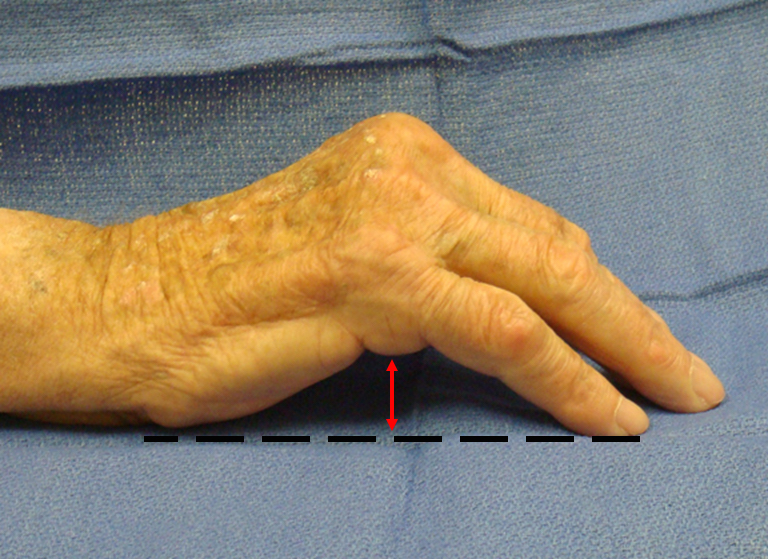
- The table-top test checks if the hand lies flat
- Finger straightening is measured
Diagnosis
- Usually a clinical diagnosis from examination
- No scans are needed in most cases
Treatment Options: A Shared Decision
I will discuss all available treatment options with you, explaining the benefits and risks of each. Your preferences, values, and lifestyle will be considered as we work together to create a treatment plan best suited to your needs — this shared decision-making process ensures you are fully informed and involved in your care.
Treatment Depends On
- How bent the fingers are
- Whether the hand can lie flat (table-top test)
- How much it limits daily activities
- Your preferences and goals
Early Dupuytren's often needs no treatment — if the hand still lies flat and function is good, keeping the hand mobile and watching it is a reasonable option.
Plan A — Non-Surgical
- Watchful Waiting: reasonable while the hand still lies flat
- Keep Mobile: gentle use and stretching may help comfort
- Monitor: track the cords and finger straightening over time
- Note: no non-surgical option reliably reverses the cords
Plan B — Surgical
Considered when…
- Contracture: fingers can no longer straighten fully
- Table-Top Test: the hand can no longer lie flat
- Daily Life: fingers catch on pockets, gloves or objects
- Progression: the bend is worsening over time
- Approach: release or removal of the diseased cord
- The Procedure: known as Cord Release, surgery divides or removes the tight cord so the fingers can straighten, usually under anaesthetic. A separate leaflet will be provided for the surgery.
Management Pathway

Red Flags — When to Seek Urgent Help
Rapidly worsening bend, or a finger that cannot be straightened at all — seek assessment, as earlier treatment can give a better result.
If you experience any of the above, contact the practice, your GP, NHS 111, or attend your nearest Emergency Department.
Important Things to Remember
- Dupuytren's is not cancerous
- Early disease often needs no treatment
- The table-top test is a useful guide
- Doing nothing is always an option
Questions You May Wish to Ask
- What treatments should I try first?
- How long should I try them for?
- What improvement can I expect?
- What happens if I don't have surgery?
Book or Enquire Directly at Each Site
| LIPS Healthcare London | 0203 870 9996 | singh.admin@lips.org.uk |
| Spire Alexandra Chatham | 01634 662866 | alexandraselfpaypsc@spirehealthcare.com |
| Practice Plus Gillingham | 01634 969045 | Private.gillingham@practiceplusgroup.com |